

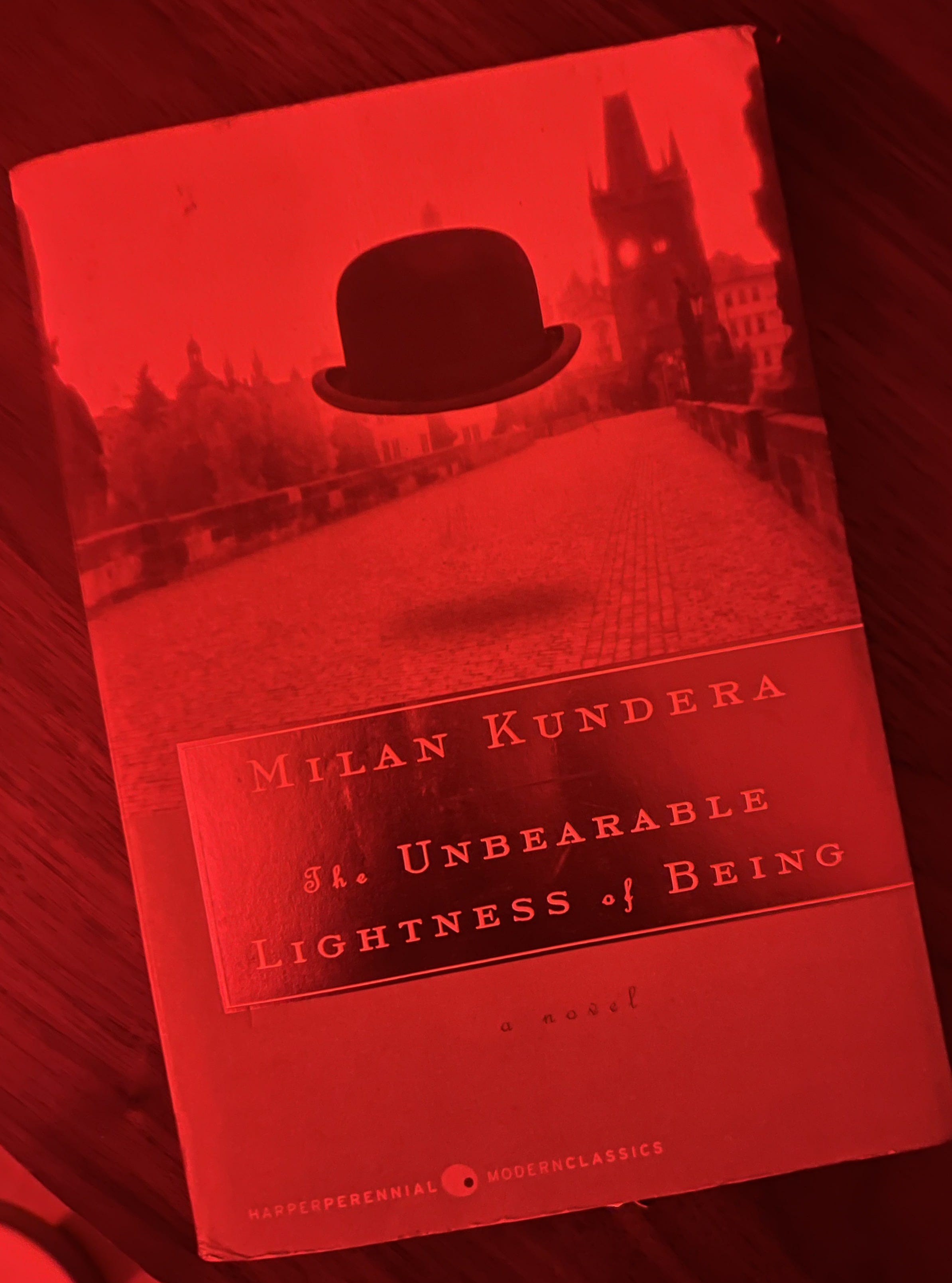
The Book
I first read The Unbearable Lightness of Being nearly five years ago because a woman I was falling in love with gave me her copy.
We were in those early months of a relationship when another person still seems inexhaustible. Every preference contains a history. Every story opens another room. You stay awake too late asking questions because it feels miraculous that another consciousness, one that existed for all intents and purposes in a vacuum before you arrived, has suddenly made itself available for exploration.
In the gusto of trying to understand her, I devoured the book, vigorously attempting to the decode her little notes in the margins of the text, and trying to come up with wise enough talking point to make myself seem more interesting.
I don’t truly remember what I thought of all of it then. I remember being taken by the central opposition Milan Kundera constructs between weight and lightness, and his characters that enact the full spectrum in between those polarities.
But I understood it intellectually, which is another way of saying that I did not really understand it at all.
Five years later, the relationship is long gone.
Strangely, it has become heavier.
This is the first paradox.
Something that happened only once, during a particular configuration of two people who no longer exist in quite the same form, has somehow acquired more gravity with time. A relationship that proved too much for us to carry remains one of the most profound experiences of my life.
And so, five years later, I find myself returning to the book she gave me.
Not because I understand it better. But because I finally understand Kundera’s questions better.
Weight
Nietzsche asks us to imagine a demon visiting us in our loneliest loneliness and who announces that this life, exactly as we have lived it, must be lived again and again, innumerable times. Eternal return.
Nothing changes.
Every embarrassment returns. Every doomscrolling afternoon. Every betrayal. Every orgasm. Every conversation you wish you could have again and every one you wish you could erase.
The same people arrive. The same people leave.
And there is no later version of you who finally gets it right.
This is eternal recurrence.
The interesting question is not whether such a fate would be horrifying. Nietzsche assumes that it might be.
The question is what your reaction to it reveals.
Could you want this?
Could you look at your life in its entirety, not merely the beautiful parts but the humiliations, failures, griefs, cruelties and stupidities, and say:
Yes.
Again.
This is the terrible weight of recurrence.
Nothing disappears because everything returns.
A choice becomes infinitely heavy because you will choose it forever.
Nietzsche pushes toward amor fati, the love of one’s fate. Not merely accepting what happened because it cannot be changed, but affirming life so completely that you would not ask it to be any different.
There is something terrifying about that.
And there is also something weirdly reassuring.
There is a significance to everything.
Under eternal recurrence, nothing simply disappears into the past. Every choice returns. Every moment bears the weight of eternity.
Nothing is lost.
And so everything becomes meaningful.
Lightness
Kundera begins by turning Nietzsche upside down.
What if there is no eternal recurrence?
What if everything happens exactly once?
Einmal ist keinmal.
Once is never.
We have no rehearsal for our lives and no second performance against which to judge the first. We make the most consequential decisions of our existence with almost no information. We choose careers before understanding what work means. We choose cities before knowing who we will become inside them. We fall in love without knowing what love will ask of us.
And then it is over.
The moment recedes into a past we cannot revisit except through the increasingly unreliable instrument of memory.
At first this sounds like freedom.
If nothing returns, perhaps nothing ultimately matters.
But absolute freedom from consequence begins to resemble meaninglessness.
This is Kundera’s unbearable lightness. A life liberated from eternal weight can become so light that nothing anchors it at all. Moments disappear as quickly as they arrive and we drift among possibilities without any cosmic mechanism declaring which one mattered.
We want freedom.
But we also want our choices to mean something.
We want lightness.
But we keep searching for weight.
Perhaps much of modern life can be understood as an attempt to resolve this contradiction.
We cannot bear the full weight of existence.
But we cannot bear its weightlessness either.
So, we manufacture representations of weight.
The Second Tear
The word kitsch came from the midst of the 19th century German Industrial Revolution and became associated with the overly sentimental, mass-produced, commercially appealing art brought on by the rise of factories.
Kundera takes the word somewhere a bit stranger. For him, kitsch is not merely gauche or bad taste. It is the aesthetic refusal of everything unacceptable in existence - what he provocatively calls the denial of shit.
Shit matters because it ruins the picture. It smells.
People who model have angles where they look nothing like their comp card. Parents can resent their children, and children can live worse lives than their parents. Lovers can become bored with each other. Revolutions can produce bureaucracies. Paris can smell like spoiled wine and piss. Gurus can become jealous. Your idols do cruel things. Martyrs die in car accidents.
Kitsch removes this.
Kundera describes kitsch through two tears. The first is the ordinary emotion of seeing something beautiful. The second comes from recognizing ourselves as part of humanity moved by that beauty. It is this second, self-reflective tear that makes kitsch kitsch.
The distinction is subtle.
The first tear says:
This is beautiful.
The second says:
How beautiful that I am the sort of person who finds this beautiful.
Kitsch is therefore not merely sentimentality.
It is sentimentality looking at inself in a mirror.
And this gives us a way of extending Kundera beyond the political and aesthetic world he was describing.
“The first tear says: How nice to see children running on the grass! The second tear says: How nice to be moved, together with all mankind, by children running on the grass! It is the second tear that makes kitsch kitsch.” — Milan Kundera, The Unbearable Lightness of Being
Kitsch begins with something difficult to represent honestly: love, grief, history, nation, spirituality, success, beauty.
It abstracts it.
It removes the contradiction or cost.
No boredom in love, doubt in ideology, discipline in spirituality, or suffering after success.
Then it returns the purified representation to us in a form we can consume.
Kitsch lets us consume an image of ourselves experiencing meaning.
It manufactures the appearance of weight without requiring us to bear any of it.
And once you start looking at modern life this way, kitsch is no longer confined to the ceramic cast figurines and sentimental paintings of the era in which it the word was coined.
It’s the old-money aesthetic that you can buy at Zara without inheritance or the complications of dynastic wealth. The authentic neighborhood sanitized from the problems of the people who made it interesting. Therapy language used to assert our inner demons. The rise of a national identity without the differences of the individual citizens. Travel without disorientation and the horror of difference. Optimization without vitality or profound ChatGPT prose generated and distributed en-masse.
If industrial capitalism learned to mass-produce objects then consumer capitalism learned to mass-produce displayed identities. We then used social media to mass-produce experiences and algorithms to mass-produce attention.
And now generative AI may allow us to mass-produce something stranger still: interiority of self.
The kitsch has been moving creeping inward.
The Kitsch of Things
A house increasingly needs to be many things.
Assetized.
Resellable.
Rentable.
Photographable.
Mortgageable.
Airbnb-able.
Legible to strangers.
This creates a peculiar pressure upon the objects around us.
Particularity reduces liquidity.
Paint the kitchen an eccentric orange and some hypothetical future buyer may hate it when the job market no longer favors your city. Install the strange tile you carried home from Morocco and you have imposed your memory on someone else’s possible future. Keep the scratched table, the mismatched cabinets, the old chair whose upholstery has faded where a body sat for thirty years, and you have allowed a particular life to interfere with the abstract value of the property.
The safest home is therefore one that offends no hypothetical person.
Gray floor.
White wall.
Black fixtures.
A suggestion of maple.
Perhaps an Edison bulb if we are really performing trendy nostalgia.
This is not an argument against millennial gray and BILLY Bookcases. They have committed no crime.
What interests me is what this represents:
maximum optionality.
Anyone can live here.
Which also means:
no one can really live here yet.
There is a waiting.
Compare that room with the house scarred by a life.
The yellow kitchen your grandmother adored.
The notch in the doorframe marking your sibling’s heights.
The scratched table from youthful boredom and mechanical pencils.
The inherited chair from the era of typewriters.
The wall you dad painted badly and never quite retouched.
These things have weight precisely because they constrain the future.
They refuse interchangeability.
The desk that you studied on in college is not replaceable with the same model from Amazon. The lamp found in the thrift store can not capture the memories of your mother studying under it in a far gone era.
The same mechanism appears at the scale of the city. Former factories become luxury lofts while retaining enough brick, steel and exposed pipe to signify the industrial labor that has otherwise disappeared. A neighborhood’s history can survive as an aesthetic after the people and activities that created it have become economically impossible there.
And naturally, the second tear:
“How beautiful it is that everyone can see me drink a $9 latte while feeling connected to the brutally raw, edgy historical image of working class New York”
We retain the representation of grit.
We remove the grit.
This is kitsch’s peculiar relationship with history. We want history’s weight without necessarily wanting history’s inconvenience. The shit.
But the distinction is not really between expensive and cheap, tasteful and tacky, old and new.
It is between possession and relationship.
Do you know who made the thing? The story of the toil and interactions and generations necessary to make a simple artifact possible.
Have you seen its failures and repaired it?
Have you lived with it long enough to know it? For every curve to feel natural in your hands.
Did it acquire meaning through your life? Through the lives of everyone who encountered it?
A plastic chair can possess tremendous weight because your father sat in it every morning for thirty years to read his newspaper. A tattered blanket can garner its weight from keeping your childhood dog cozy. A bar of chocolate can bear its significance from the giver of the gift. And a forty-thousand-dollar watch that looks indistinguishable from the knockoffs can remain completely weightless because price itself does not create weight.
Relationship does, and those layers aren’t easily chargeable to your credit card.
The Kitsch of Experience
Something extraordinary happened when we began describing paintings, essays, photographs, jokes, films, political arguments, thirst traps, recipes, wars and someone’s Istanbul breakfast with the same word:
content.
Their differences collapse at the level of the feed.
Everything comes as fodder. Slop.
A friend’s engagement.
A GLP-1 advertisement.
A poem.
A child dead in war.
A meme.
The one spot in LIC you can’t miss.
A breakup announcement.
A get ready with me video.
All back to back.
Scroll.
Scroll.
Scroll.
Everything becomes equivalent at the level of delivery.
The flattening extends beyond what we consume and into what we experience.
Travel once imposed foreignness upon the traveler almost by necessity.
You do not know this language.
Breakfast isn’t what breakfast is supposed to be.
The train has its own mind on when it will leave.
You mispronounce something, repeatedly.
You eat something egregious and discover it’s the local staple.
You are lonely, jet-lagged, and lost.
For a little while, the assumptions that quietly organize your ordinary life stop working.
Foreignness destabilizes you.
Much of modern travel infrastructure is designed, quite reasonably, to eliminate these inconveniences.
Uber.
AirPods.
Google Maps.
Instant translation.
International hotel chains.
Reducing the storm that just affected everyone at your destination to a two hour delay.
English menus.
Instagram pinned itineraries.
Global coffee aesthetics and the latest global pastry trend.
The same clothes.
The same music.
The same phone.
It is increasingly possible to travel thousands of miles without undergoing much displacement at all.
You can move across the Earth while remaining psychologically at home.
And then, having protected ourselves from foreignness, we can photograph the journey as evidence that we encountered it.
We can queue to produce nearly identical photographs of supposedly singular experiences: Almafi Coast. Dumbo. Taj Mahal.
Thousands of unique journeys converge upon the same representation.
The first tear says:
This place is beautiful.
The second tear:
Look how worldly I have become.
But there is another trap here.
Perhaps the exhausted American eating McDonald’s in Kyoto because he genuinely wants fries is less kitschy than the traveler forcing himself into the “authentic hidden hole in the wall ramen shop” he found on TikTok so that he can perform the aesthetic of having another authentic Japanese experience.
Authenticity, once made legible, becomes reproducible.
The crying selfie.
The messy carefree bedroom.
The analog Fujifilm camera.
The handmade ceramic.
The obscure wine that’s now trending enough to secure a distribution contract at Target.
The local coffee shop owned by Nestle.
The unfiltered photograph that required fifteen attempts to look unfiltered with cameras arranged around the room to capture every perfect angle.
Even rebellion and counter culture develops a recognizable performative visual language
We wanted to escape mass culture by becoming individuals.
The market responded by giving us thousands of ways to purchase individuality.
Therein lies the second paradox.
The Kitsch of the Self
To optimize something, you must first make it legible.
You need a variable.
Health becomes VO2 max and HRV, peptide stack, steps and sleep score.
Beauty becomes jawline, skin, QOVES analysis, muscle, symmetry, and the number of steps in your skincare routine.
Career becomes salary, pedigree, title, funding rounds, network, followers, and LinkedIn reposts.
Travel becomes countries visited, points accumulated, statuses matched, restaurants saved.
Intellectual life becomes Goodreads challenges, podcasts consumed at 2.5x, Kindle notes captured, and the raw accumulation of data in your second brain.
Eventually the self becomes a dashboard with different variables to tinker with.
There is nothing inherently wrong with measurement. A metric can reveal something our mind filters it out of reality.
The danger begins when the proxy replaces the thing it was supposed to measure.
You start stressing over your cortisol response.
You stop understanding books and start completing books, bottoming out at the easier and more salacious the better.
You buy a phone swinger to get your steps in.
You let AI give you an A- essay, instead of massaging your thoughts long enough for taste to develop.
You stop developing taste and start acquiring tasteful objects. The more niche the aesthetic the more edgy you are.
You stop building relationships with people you enjoy being and building with and start maintaining a network.
In sum, you stop living a good life and start optimizing for the measurable associations of a good life.
Optimization can produce the measurable appearance of flourishing without flourishing itself.
Here kitsch ceases to be merely aesthetic.
It becomes epistemological. A simulacrum.
We replace an unruly reality with a legible representation and eventually forget that the representation was an abstraction.
This may explain some of the absurdity of contemporary maxxing culture.
Once every part of the self becomes a variable, nothing is too intimate, ridiculous or anatomically obscure to escape optimization. Jawline. Skin. Hair. Sleep score. Social status. Sexual marketplace value. Even one’s apparent imperfections can become strategies posted on forums.
The joke almost writes itself because the logic has already become comic.
But optimization is only one manifestation of something larger.
Modern life offers an expanding marketplace of ready-made internal experiences.
The corporate layoff becomes a strategic realignment.
Despair becomes a growth season.
The difficulties of relationship becomes a problem of boundaries or attachment style incongruity.
A mandatory corporate retreat manufactures trust on a deadline.
Loneliness becomes an opportunity to work on yourself.
None of these languages is necessarily false. Boundaries can be necessary. Growth can follow suffering. Teams can become communities. Metrics can improve health.
Kitsch begins when the representation becomes incapable of admitting what contradicts it.
When every failure must become a lesson, we lose the right to have shit failures that remain failures.
When every wound must become growth, grief loses the right to remain irrecoverable grief.
When every year must become a narrative arc, life becomes intolerably good at foreshadowing.
And yet the shit returns eventually. Reality insists.
The Kitsch of Thought
The original Luddites were not simply people frightened by machines.
They were skilled textile workers confronting an industrial transformation that changed not only how cloth was produced, but who possessed skill, how workers were paid, where production happened and who captured the benefits of increased production. Many objected to particular uses of machinery and labor arrangements rather than to technology in the blanket abstract.
Their struggle raises a question that has become newly important:
Which friction is merely an obstacle to remove, and which friction is secretly constitutive of the thing we value?
Technology has always removed friction.
The loom changes the relationship between skill and cloth.
The camera changes the relationship between seeing and representation.
Recorded music changes the relationship between performance and listening.
Spotify changes scarcity, sequence and discovery.
Google Maps changes getting lost.
Instagram changes social connectivity.
None of these transformations can be reduced to simply good or bad. Removing unnecessary friction is one of civilization’s great achievements.
I am grateful that I do not have to milk my own cow and grind my own wheat every morning to eat toast with butter.
But sometimes the obstacle and the process cannot be cleanly separated.
Generative AI makes that distinction critically difficult.
A poem exists on my blog, but did I wrestle with language and the profoundness of my experience?
An image represents an aesthetic, but did I learn to see?
An essay exists, but did I think through my relationship with the words?
A love letter exists, but did I erase and rewrite enough lines inexhaustibly to come up with words that still can’t capture my feelings?
The interesting question is not whether AI can produce great art.
I believe it can.
The stranger question, and the more poignant one, is:
What happens to us when excellence in the result no longer implies transformation in its maker?
For most of human history, certain artifacts served as somewhat-imperfect-but-still-reliable evidence of processes that had occurred inside people.
The pianist’s performance implied years of practice.
The carpenter’s scarred table implied knowledge residing in hands.
The essay implied that someone had spent time thinking.
The letter implied that someone had searched for words.
Generative systems loosen this relationship.
They offer an newfound possibility: the artifact of transformation without the transformation.
This concerns me more extensively than the raw accumulation of computational prowess.
And I know this because it happened while writing this essay.
I asked a machine to write part of it.
I gave it ideas I had been circling, fragments about Kundera, and kitsch, brainrot, millennial gray, and a woman I once loved, and asked it to show me what the section might become.
The machine produced something beautiful.
It moved me. It sounded like me.
And almost immediately, I felt something closer to disgust.
Not because the words were bad.
Because they were good.
Really good.
The words felt right.
But I had not earned them.
I had not wandered there myself.
And what exactly did I believe I would be stealing if I copied them?
The sentence? Or the process of becoming the person capable of writing them?
The Machine That Wrote This Sentence
There is, of course, an irony in writing any of this with the help of a machine, on a machine, to be broadcast to all the other machines on which it will be read.
I can ask it to find the word I cannot find.
I can give it a half baked thoughts and ask it to finish baking it.
I can ask it to connect Nietzsche and Kundera, kitsch and architecture, an obscure YouTube video about gray houses and an Instagram photograph and the quantified self.
I can even ask it to make the argument sound more like me.
The sentence appears. Everyone else can see it.
But did I think it?
And yet even this distinction is suspiciously convenient.
There is a particular egoic pleasure in recognizing kitsch.
Once you learn to see it, the world becomes morbidly easy to diagnose.
The millennial gray apartment or the industrial coffee shop. The LinkedIn confessional masquerading as growth. The meditation retreat and the old money shoes. The traveler waiting in line to photograph the same icon from the same angle as everyone else. The West Village girl who would never go above 14th Street. The tech worker reformed as an artisan. The struggling image of performative poverty. The billionaire trying desperately to look like he inherited his cashmere. The influencer filming herself crying. The man optimizing his jawline, sleep score, morning routine, testosterone, and VO₂ max in the hope that enough perfected variables might eventually add up to a person, or even more terrifyingly, acceptance.
Once you have the vocabulary, kitsch is everywhere.
And there is something intoxicating about being the person who notices.
How wonderful that I am not like them.
There it is.
The second tear.
How wonderful that I am sophisticated enough to recognize the artificiality of everyone else’s life.
Perhaps anti-kitsch is simply kitsch for people who know what kitsch is.
The handmade ceramic mug can become kitsch. So can the gourmand who fusses over natural wine, the obscure neighborhood that is really the heartbeat of the city, the rare Neutral Milk Hotel LP, the Leuchtturm notebook with the dot grid, the jhana meditation practice, the insistence on buying only heirloom tomatoes, or the refusal to download ChatGPT.
There is no aesthetic that cannot eventually become an aesthetic of authenticity, no rebellion that cannot become sufficiently legible to be packaged and sold.
Even friction can become a fetish. A performative caricature of intent.
The person taking the subway when an Uber would save them an hour. The person writing by hand when an email is needed. The traveler refusing Google Maps in pursuit of some supposedly purer encounter with foreignness, wanderlust, and self reliance. The person listening to vinyl not because they love records, but because they love being the kind of person who is seen listening to vinyl.
There is no shopping list for escaping kitsch.
You cannot purchase your way out of it.
You cannot aestheticize your way out of it.
You cannot optimize your way out of it.
And, apparently, you cannot write an essay about it without risking another version of the same performance.
Because somewhere in writing this essay, another uncomfortable possibility occurred to me.
I began with a woman.
Five years ago, my then girlfriend gave me her copy of The Unbearable Lightness of Being. We were still in that early period of a relationship when another person seems inexhaustible. Every story opens another room where you stay awake too late asking questions because it feels miraculous that an entire other consciousness has somehow opened itself to you.
I devoured the book. I was, in another sense, devouring her too.
I wanted to know everything. The childhood stories. The contradictions. The private theories. The things she hated for reasons she couldn’t quite explain but made me relish in the schadenfreude of her externally directed ire. The strange little preferences that seemed arbitrary until some story made them inevitable. I wanted to understand how a person becomes this particular person and no other.
For a while, I thought I did.
The relationship ended. Years passed.
And somewhere in those years, the person I knew became a person I remember.
Memory is a ruthless editor.
It cuts the waiting. The repetition. The arguments whose premises I can no longer reconstruct. Or an afternoon when neither of us was particularly interesting or appealing. The moments of selfishness. The things I said that I wish I had or hadn’t. The things she said or did that hurt me.
It keeps stranger things.
The private language. The inside jokes. The smell of her hair. The particular way gravity shifted when we were in the room together. The feeling of sitting beside each other without needing the moment to become anything more than itself.
The boredom. The resentment. The sex. The tenderness. The irritation. The laughter. The cruelty you discover yourself capable of. The darkness of two souls meeting. The generosity you didn’t know you possessed.
The terrible inconvenience of loving someone.
And then memory takes thousands of moments, exuberant and banal and caustic and ordinary, and compresses them into a sentence:
It was one of the most profound experiences of my life.
What is that if not a kind of kitsch?
I have spent this essay accusing modernity of taking complicated things, stripping away their contradictions, and returning them to us as beautiful, legible representations.
And here I am doing precisely that to someone I loved.
I can look at fragments of the life she lives now and tell myself a story about what she became. A neighborhood. A career. The people around her. The signs and symbols of a world we once talked about differently.
If I am feeling wounded, I can call it compromise.
If I am feeling superior, I can call it hypocrisy.
If I am feeling gracious, I can call it growth.
If I am feeling sentimental, I can call it adulthood.
If I am missing her, I can turn it into tragedy.
Each story tells me something.
None of them tells me what it is like to be her.
That is the inconvenient truth.
I don’t know her anymore.
Or perhaps more precisely, I know someone who no longer exists.
I know the woman who handed me a book five years ago. I know fragments of the person she became afterward. Between them lies an entire private life I did not witness.
She changed.
I changed.
Of course we did.
Perhaps the more kitschy fantasy would be insisting that either of us owed permanent fidelity to the people we happened to be when we loved each other.
There is another cruelty in nostalgia. It freezes people at the moment they mattered most to us and quietly resents them for continuing to live.
The real person keeps moving.
She will have acquired tastes I’ll never know. Changed her mind about things she once believed with conviction. Will love people I’ll have never met. Created rituals I cannot recognize. She wakes up on ordinary Tuesdays and thinks thoughts in which I do not exist.
She becomes unknowable again.
And perhaps this is why kitsch cannot simply be defeated by choosing the authentic thing.
Memory itself is representation.
Language is representation.
An essay is representation.
To tell a story at all is to select, compress, arrange, craft, and perform.
Context must compress.
And any life remembered is necessarily lossy.
We could not carry the full resolution of reality even if we wanted to. It would be unbearable.
So perhaps the danger is not representation itself, it is forgetting that something infinitely less legible once existed underneath it.
The kitsch isn’t the simplification. It’s the forgetting that you simplified.
An archetype instead of a person.
A lesson instead of a relationship.
A set of stories instead of a life.
And when I strip away everything I have subsequently made that relationship mean, I am left with something embarrassingly simple.
I miss her.
There is no philosophy in that sentence capable of making it cleaner.
No theory of recurrence changes the fact that it happened only once. No amount of remembering gives either of us another attempt. No machine can regenerate the precise consciousnesses we were then and ask them to choose differently.
Einmal ist keinmal.
Once is never.
Kundera may have been right about the terrible lightness of a life without rehearsal.
And yet I cannot convince myself that once was nothing.
The relationship happened once.
That particular world happened once.
Those versions of us happened once.
And then they disappeared.
She continued into a life beyond my knowing. I continued into mine.
Still, something was altered.
Perhaps weight does not come from recurrence after all.
Perhaps weight enters a life wherever something is allowed to leave a mark.
The chipped bowl becomes yours because you kept it after the argument slipped it from your hand.
The empty bottle that looks like trash to someone else contains a night they cannot see.
A city becomes home because you stayed through the harsh winter, when nobody was jealous of your days there.
A craft becomes yours because your hands refused to listen to you a thousand times.
Another person becomes part of you because loving them changed what you were free to be.
Maybe this is what I misunderstood when I first read Kundera.
We cannot make our lives recur eternally. We cannot know beforehand which choices will justify themselves. We cannot rehearse loving someone before deciding whether the consequences are worth it.
We can only choose what we are willing to let constrain us.
Inconvenience us.
Disappoint us.
Change us.
What weight we are willing to carry when no one gives a shit.
What we are willing to love without first knowing what it will become, or what we will become.
Five years ago, she handed me a book about the unbearable lightness of a life that happens only once.
Five years later, I think I understand something I didn’t then.
It was unbearably light.
It was unbearably heavy.
It happened once.
And yet, it only needed to happen once.